Street Fighter Review: Fan Service Isn't a Substitute for a Movie
Street Fighter has exciting fights and stunning animation, but its incoherent tone, wasted tournament, and relentless jokes make it a frustrating adaptation.
Spoiler-free.
I went to see Street Fighter for a pretty simple reason: there wasn’t much else playing that fit my schedule, and I figured a ridiculous, over-the-top fighting movie would be an entertaining way to spend a couple of hours.
I wasn’t expecting high art. I wasn’t looking for some profound exploration of the human condition. I just wanted to watch a bunch of colorful characters beat the hell out of each other, enjoy some familiar moves and music, and have a good time.
How difficult could that possibly be?
Apparently, extraordinarily difficult.
I’m genuinely struggling to describe what I watched. Street Fighter is one of the most tonally confused movies I’ve seen in a long time. It feels like someone combined an episode of The Eric Andre Show, an extended Saturday Night Live sketch, a collection of video-game cutscenes, and a martial arts tournament, then decided to make all of them into a single movie without considering whether any of it actually worked together.
The result is something that never quite manages to be funny, serious, exciting, or even particularly coherent.
And the most frustrating part? There are glimpses of a genuinely good Street Fighter movie buried inside it.
A movie that doesn’t know what it wants to be
Let’s establish something right away: Street Fighter is inherently ridiculous, and that’s perfectly fine.
We’re talking about a franchise where people throw fireballs, perform physically impossible martial arts, and compete against opponents ranging from military commandos to enormous green monsters. Nobody needs this material to become a gritty, realistic drama.
But there’s a difference between embracing absurdity and treating absolutely everything like a joke.
Director Kitao Sakurai seems determined to make every scene as outrageous as possible, frequently at the expense of the story itself. The movie jumps between slapstick comedy, outrageous performances, exaggerated sexuality, serious character drama, and explosive action without ever finding a convincing balance.
Some of the characters are downright awful. Eric André’s performance as Don Sauvage was particularly grating to me, and unfortunately, the style of humor surrounding him seems to infect much of the movie.
I know what The Eric Andre Show is trying to accomplish. I can appreciate absurdist comedy when that’s what I signed up for. But watching a beloved fighting-game franchise seemingly reduced to an extended parody of itself is another matter entirely.
There’s also a surprising amount of sexualized humor and imagery that feels thrown in simply because the filmmakers could. It rarely adds anything to the characters or the experience.
At times, I honestly wondered whether the movie was even interested in being a Street Fighter adaptation, or whether it was primarily interested in mocking the idea of one.
And that uncertainty makes it very difficult to care about anything happening on screen.
The animated sequences are incredible. That’s part of the problem.
For all my criticism, I have to give the film credit where it’s due.
The fight choreography is often entertaining, the special effects are impressive, and the familiar music from the games sounds great.
But the real highlight is the animation.
The anime-style flashbacks are absolutely stunning. They have weight, atmosphere, gravity, and a genuine sense of dramatic purpose. When the film transitions into these sequences, suddenly the characters feel like they belong to a world with history and consequences.
I found myself substantially more invested in those moments than in almost anything happening in the live-action story.
And that’s a serious problem.
The animated sequences demonstrate that Street Fighter doesn’t need to abandon its fantastical identity to tell a compelling story. The characters can still be exaggerated, the fights can still be spectacular, and the world can still be completely absurd.
They just need to take that world seriously enough for the audience to become invested in it.
Instead, the film repeatedly transitions from these beautifully realized dramatic sequences into something resembling a farcical comedy.
The contrast is so severe that it almost feels like two entirely different productions competing for control of the movie.
I’m not suggesting that Street Fighter should have been entirely animated. I’m suggesting that the live-action film could have learned something from its own animated sequences.
You can have humor and levity without making a joke out of the entire experience.
Can we please just have a tournament that matters?
This is perhaps my biggest frustration with fighting-game adaptations in general.
Why is it apparently so difficult to make a movie about an actual fighting tournament?
The structure practically writes itself.
Introduce your fighters. Establish their motivations and rivalries. Give them something meaningful to win or lose. Let the competition gradually increase in intensity until the strongest characters finally confront one another.
There’s nothing especially complicated about that formula, and there’s plenty of room for character development, humor, spectacle, and surprises along the way.
But for whatever reason, these adaptations continually seem determined to make the tournament the least important part of the movie.
Street Fighter is no exception.
The World Warrior Tournament should be the foundation of the entire experience. Instead, it’s treated almost like an inconvenience the filmmakers occasionally remember exists.
We barely get to experience many of the actual tournament fights. Several confrontations are skipped or interrupted, and the competition itself never develops the tension or progression that makes a tournament exciting.
Even worse, the outcome never feels particularly consequential.
Why should I care who wins? What does winning actually accomplish? What are the stakes beyond simply allowing the plot to continue?
The film never gave me satisfying answers.
And then there’s M. Bison.
David Dastmalchian is playing one of the most recognizable villains in fighting-game history, and yet I found his character almost completely ineffective. He isn’t particularly funny, intimidating, or compelling. His pursuit of power feels vague, and he spends much of the movie doing surprisingly little to establish himself as a meaningful threat.
The tournament and the villain should be working together to create an escalating sense of danger.
Instead, both feel oddly disconnected from the experience.
I enjoyed Mortal Kombat II more than this, and that wasn’t exactly high-class cinema with an extraordinary screenplay. But it understood what kind of entertainment it was trying to deliver and generally did its job.
Street Fighter seems to have forgotten the assignment entirely.
Fan service is not filmmaking
There’s something about modern video-game adaptations that has increasingly started to frustrate me.
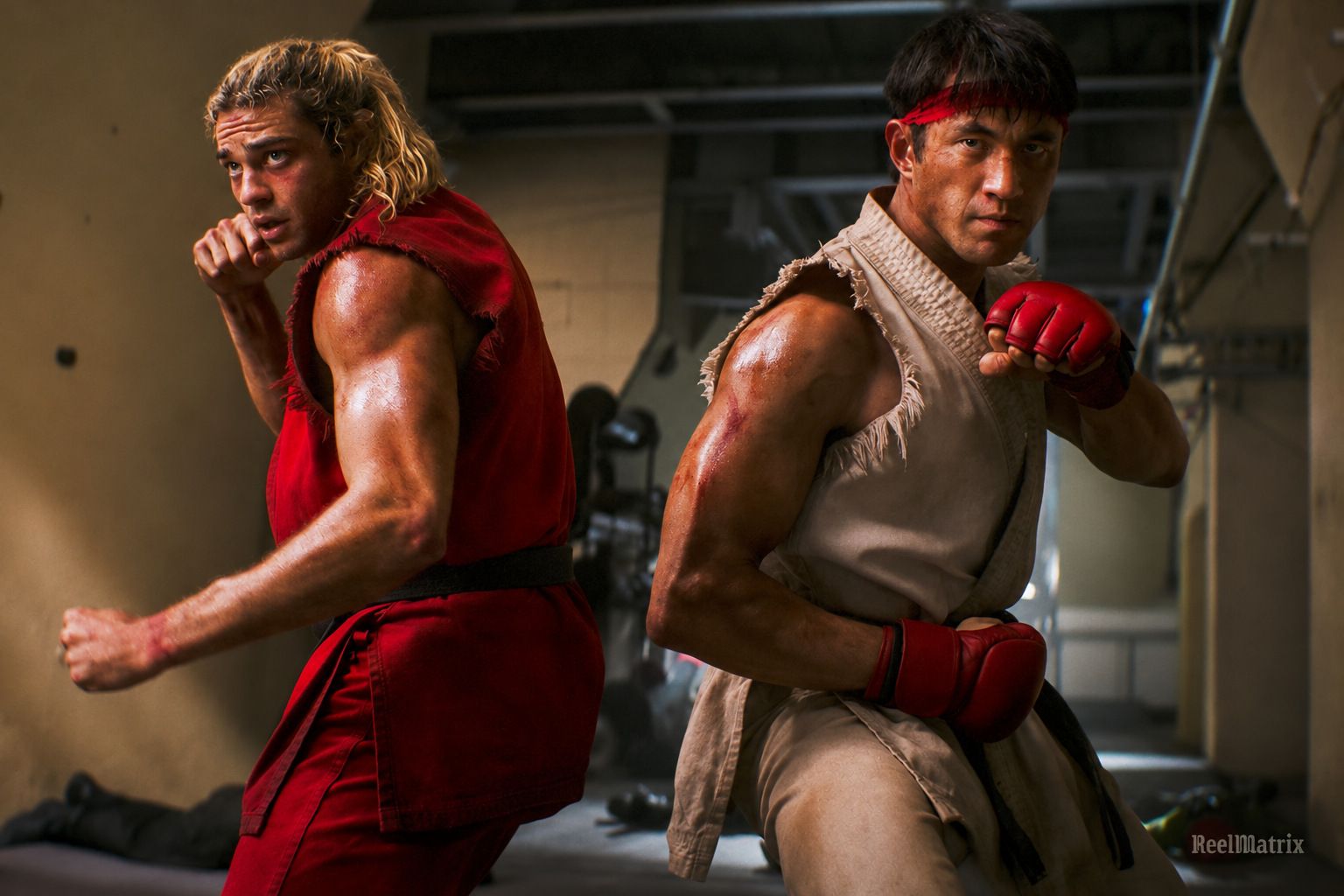
Whenever one of these movies comes along, so much of the conversation seems to revolve around the number of Easter eggs it contains, how accurately the characters resemble their game counterparts, whether somebody says an iconic line, or whether we get to see a recognizable special move.
And apparently, if the filmmakers include enough of those things, we’re supposed to overlook whether the movie itself is any good.
I don’t buy that.
I appreciate fan service. I enjoy recognizing something I grew up with. There’s absolutely something satisfying about hearing familiar game music or watching a character perform a move you’ve executed hundreds of times yourself.
But those things should complement an entertaining movie.
They shouldn’t be the reason we’re expected to forgive a bad one.
Here’s the question I kept coming back to while watching Street Fighter:
If you removed the recognizable characters, signature moves, music, and Easter eggs, would anybody genuinely defend this movie on its own merits?
Imagine the exact same story, performances, dialogue, and tonal inconsistencies, only with entirely original characters.
Would audiences still celebrate it as an entertaining action movie?
I have a difficult time believing they would.
And I think that’s becoming an unfortunate problem with adaptations of beloved intellectual property. Recognition is increasingly being confused with quality.
A movie doesn’t become good simply because it correctly remembers what made the source material popular.
It has to translate those qualities into an experience worth watching.
Hollywood’s obsession with turning everything into a joke
There’s another broader issue that Street Fighter illustrates particularly well.
Ever since Marvel demonstrated how commercially successful a combination of action, humor, and interconnected storytelling could become, it feels like an enormous portion of Hollywood has been trying to reproduce that formula.
And I’m getting tired of it.
Humor belongs in movies. Even serious movies benefit from moments of levity. Some of the most emotionally powerful stories ever told understand when to make their audience laugh.
But the key is knowing when to stop.
A serious moment needs room to breathe. A threatening villain needs to actually feel threatening. A character’s struggle needs to matter long enough for the audience to become invested.
You cannot constantly undermine the gravity of your own story and then expect everyone to suddenly care when something important happens.
Street Fighter seems almost terrified of taking itself seriously for more than a few minutes.
And the frustrating irony is that its animated sequences demonstrate how effective that seriousness could have been.
It’s the same formulaic approach we’ve seen repeatedly elsewhere: interrupt the tension with a joke, reference something familiar, throw in another exaggerated character, and keep moving before the audience has time to consider whether any of it makes sense.
Eventually, the jokes stop being funny because there’s nothing meaningful for them to contrast with.
And the action stops being exciting because the movie has given us no reason to care.
Stop making advertisements for sequels
Perhaps nothing represents my frustration with modern franchise filmmaking better than the way so many movies seem more interested in setting up their sequels than completing the story they’re supposed to be telling.
Street Fighter eventually reaches a point where it’s clearly laying the groundwork for another adventure.
But why should I be excited?
I barely cared about the conflict in the movie I was already watching.
The filmmakers appear to be operating under the assumption that simply assembling recognizable characters and promising another confrontation will automatically create anticipation.
It doesn’t.
A sequel should be something an audience wants because the first film earned their investment.
Instead, we’re increasingly presented with incomplete-feeling stories that seem designed around the possibility of a franchise rather than the responsibility of delivering a satisfying movie.
And financially, that’s a dangerous gamble. There’s no guarantee a sequel will ever materialize, particularly if the original struggles to justify another investment.
Why spend so much time promising something better tomorrow when you haven’t made something worthwhile today?
Final thoughts
I don’t think Street Fighter is completely terrible or unwatchable.
There are genuinely entertaining fights, impressive visual effects, excellent animated sequences, and moments where the familiar game music captures exactly the kind of excitement I hoped the movie would deliver.
But those strengths are surrounded by such an incoherent collection of tonal shifts, obnoxious comedy, questionable creative decisions, and poorly developed stakes that I eventually stopped caring about the story entirely.
And that’s what makes this so disappointing.
I didn’t walk into the theater expecting a masterpiece. I just wanted a fun fighting movie.
There was a perfectly good premise sitting right in front of the filmmakers, complete with memorable characters, established rivalries, a tournament structure, and an iconic villain.
Somehow, they managed to make all of those ingredients feel almost irrelevant.
5/10. A bizarre, tonally incoherent adaptation whose impressive action and beautiful animation occasionally rescue it from its own screenplay. There are flashes of something worthwhile here, but fan service and recognizable characters cannot substitute for an actual movie.
Spoilers: When the stakes disappear entirely
The final act perfectly illustrates why the film failed to hold my attention.
When Akuma finally appears and the sky begins darkening, the movie is clearly trying to establish an enormous, climactic threat.
But by then, I was completely disconnected from the stakes.
The story hadn’t earned the gravity of that moment, so all the ominous presentation in the world couldn’t convince me to care.
Ryu ultimately defeats Akuma, and rather than feeling like the culmination of a meaningful journey, the confrontation comes across as another spectacle the movie needed to check off its list.
Then we get the suggestion that the characters will unite against Bison in a future installment.
And my immediate reaction was: why?
Bison hadn’t been established as a particularly compelling villain, the tournament hadn’t amounted to much, and the movie hadn’t done enough to make me emotionally invested in these characters as a group.
So why would I be excited to watch them fight him in another movie?
That’s the problem with treating a franchise setup as a substitute for a satisfying conclusion.
The audience needs to care about the story in front of them before they’ll care about what might happen next.
The verdict
5/10
Impressive action and animation can't rescue a tonally incoherent adaptation that treats its tournament, stakes, and characters like an afterthought.