Ebenezer Review: The Light and Dark We Choose to Carry
I walked into Ti West's A Christmas Carol expecting an unnecessary retelling and walked out unexpectedly moved. Johnny Depp's wounded Scrooge reminded me why a familiar story can still matter.
Advertisement
This review discusses major plot points. If you haven't seen it yet, the verdict at the bottom is safe.
I spent the first act of Ebenezer thinking I might give it a 4.5 out of 10.
By the time the credits rolled, I had settled on a 9/10, and I’m not ashamed to admit I teared up more than once along the way.
That’s not a normal progression for me. A movie rarely nearly loses me in its opening stretch and then moves me so unexpectedly by the end. But that’s exactly what happened here, and the more I’ve thought about it, the more I appreciate what this movie accomplished.
I had actually tried to see Ebenezer a few days earlier. A doctor’s appointment for my daughter changed my plans, then a major traffic accident changed them again, and I ended up seeing Ghost Soldier instead, my third choice in an increasingly ridiculous afternoon. So when I finally got around to Ebenezer, it felt like a movie I’d been chasing for a while.
I knew what I was walking into, or at least I thought I did.
We’ve all seen A Christmas Carol. We’ve seen it played straight, played for laughs, animated, modernized, and reimagined in practically every way imaginable. We know Ebenezer Scrooge. We know the ghosts. We know the lesson. We know the ending. And the marketing for this adaptation leaned into the familiar promise that we only think we know the story, and that this time we’d see something different.
Well, for a good portion of the movie, I was sitting there thinking, No, actually, I do know this story. This is the same story.
And it is.
But somewhere along the way, my disappointment turned into appreciation. Not because Ti West pulled the rug out from under me or revealed some extraordinary twist in Dickens’ tale, but because I started recognizing just how much care had gone into telling it. The direction, the performances, the atmosphere, the special effects, and, most importantly, the humanity all came together in a way that caught me completely off guard.
I was waiting for the filmmakers to show me a different A Christmas Carol. Instead, they reminded me why this one matters.
The story I already knew
Let’s get my biggest criticism out of the way, because I don’t want to pretend my initial disappointment was imaginary just because I ended up loving the movie.
Ebenezer does very little to distinguish its central story from the countless adaptations that came before it. Its structure is familiar. Its revelations are familiar. The journey from past to present to future is familiar. If you’ve spent any meaningful time with Dickens’ story, you can practically anticipate the emotional beats before they arrive.
That isn’t necessarily a flaw, but it becomes one when a movie invites you to expect a reinvention and then delivers an extremely faithful adaptation instead.
During the first act, I honestly wondered what the point was. The production looked fantastic and the acting was clearly strong, but I couldn’t shake the feeling that we were going through the motions of a story everybody in the theater already understood. I was preparing to call it a beautifully made but largely unnecessary retread.
By the second act, I was reconsidering. I had climbed to something like a 6.5 or a 7. And by the end, I realized the problem wasn’t that the film had failed to invent a new Scrooge. It was that I’d been so busy waiting for something new that I nearly overlooked how well it was presenting what was already there.
I still think the marketing oversells the novelty, and viewers looking for a radically different take might share my early frustration. But I came away with a renewed respect for the value of a faithful adaptation. Familiarity doesn’t prevent a story from being powerful. Sometimes it allows the storytelling itself to become the point.
Johnny Depp understands the man beneath the miser
Johnny Depp is in a class of his own here.
What’s funny is that his portrayal was part of my initial disappointment. When I think of Scrooge, I think of the classic bitter, mean-spirited old man whose entire personality revolves around being unpleasant until the ghosts finally teach him to be nice. That’s the version we’ve grown used to, and I think it’s the version I subconsciously expected.
Depp doesn’t quite play him that way.
From early on, there was something about Ebenezer that didn’t feel cruel or heartless at his core. He could certainly be cold, dismissive, and unfair, but underneath those behaviors I sensed a man who was guarded. A man who had been hurt. Someone who had spent so long protecting himself that he no longer seemed to know how to let anyone get close.
At first, I wasn’t sure I liked that choice. By the end, I thought it was brilliant.
The story shows us someone who experienced precious little unconditional love in his life. When he did find it in his sister, he lost her. When he had the chance to build a life with a woman who adored him, he couldn’t bring himself to trust what she was offering. And even with his nephew, who keeps reaching toward him with remarkable patience, he keeps finding reasons to stay at a distance.
What I saw in Depp’s performance was not a man who didn’t know what love was. It was a man who knew enough about losing it to become frightened of receiving it again.
Somewhere in that pain, he’d come to associate love with usefulness. With what a person could provide, and whether there was some practical reason for affection to exist. Money, work, business, and the security of things he could measure became easier to trust than people.
That’s such a sad way to live, because it means every invitation to be loved becomes another potential threat.
Depp lets that inner life sit beneath the surface. He doesn’t announce every feeling or turn Scrooge into a sympathetic saint. The man still behaves badly. But there’s a difference between portraying someone as a cartoon villain and portraying someone whose humanity has been buried under years of habitual misery.
This movie understands that distinction, and Depp makes it work.
A beautiful, haunted production
I don’t want the emotional side of this review to overshadow the filmmaking, because on a technical level I thought Ebenezer was excellent.
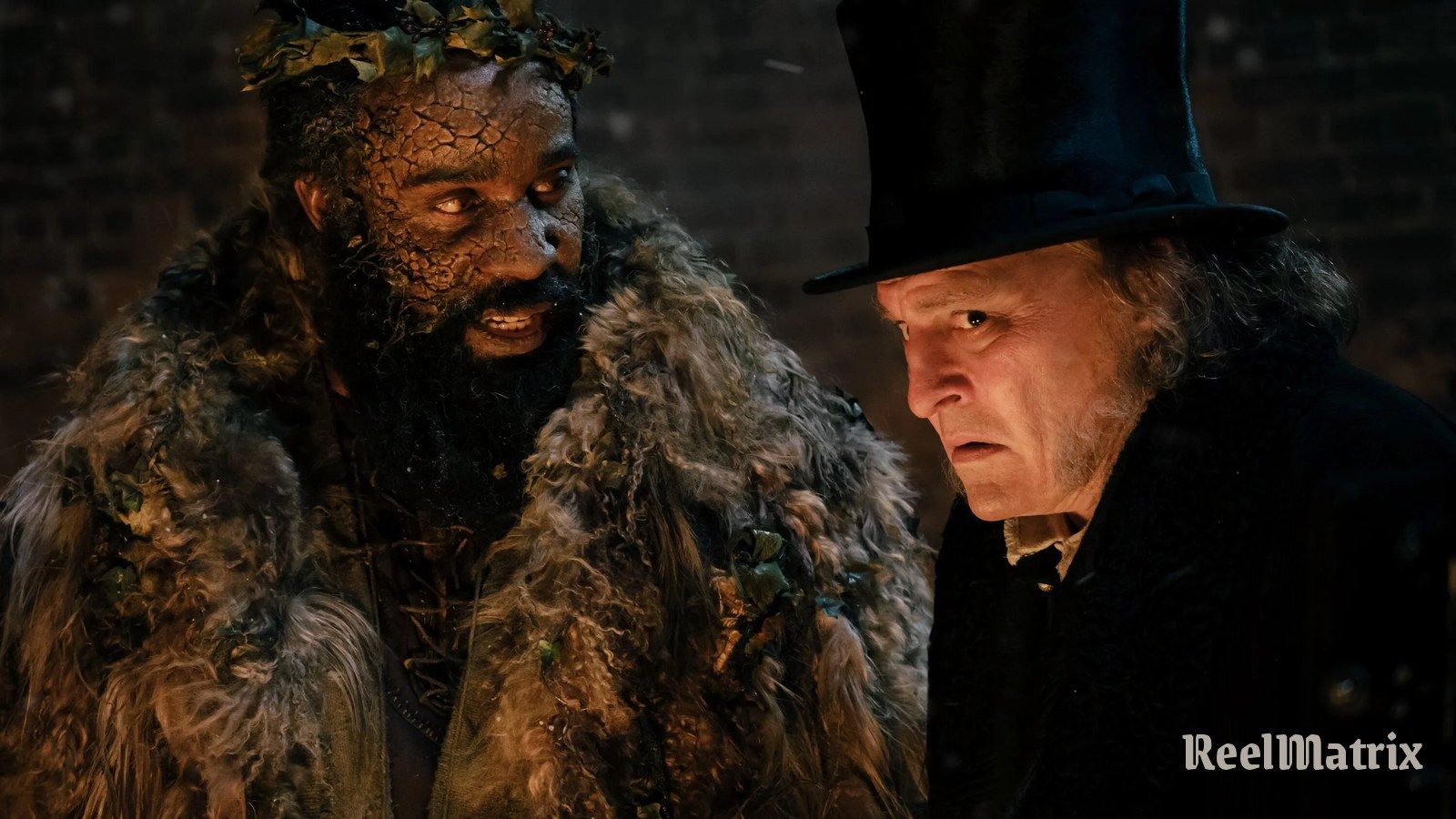
Ti West directs the material with real confidence. The period setting feels lived in, the gothic atmosphere suits the supernatural side of Dickens’ story, and the film is often gorgeous to look at. The special effects are impressive without making the ghosts feel as though they’ve wandered in from a completely different kind of movie.
There’s a wonderful balance between the grandeur of the supernatural encounters and the smaller human moments that give them meaning. The ghosts are visually memorable, but they aren’t the point. They’re there to bring something out of Ebenezer that he has spent years refusing to confront.
The supporting cast deserves credit, too. Ian McKellen gives Jacob Marley a memorable presence, Rupert Grint brings warmth and vulnerability to Bob Cratchit, and Sam Claflin and Daisy Ridley make the nephew’s household feel like a genuine alternative to the isolation Ebenezer has chosen. The film is full of recognizable faces, but I never felt their presence was simply an excuse to assemble an impressive cast list.
And the emotional journey is paced better than I initially gave it credit for. The first act may be familiar, but the relationships established there become more meaningful as the film goes on. The movie doesn’t suddenly transform into something else. It gradually reveals why its choices matter.
That requires patience from the audience, and I’ll admit I didn’t give it much at the start. I’m glad I stuck with it.
The past can become a place we never leave
What finally connected with me was something more profound than the usual lesson about a wealthy old miser learning to be generous.
I started thinking about how our past can shape us so deeply that we spend the rest of our lives repeating it.
A painful experience becomes a fear. That fear becomes a habit. The habit becomes the way we treat people. And eventually we’re carrying something that happened years ago into every new relationship and every new opportunity, creating a cycle that keeps us living inside the same old hurt.
I’ve come to think of that as a kind of sickness, not necessarily in a medical sense, but in the way spiritual, emotional, and mental wounds can become patterns we keep practicing long after the original injury is over.
And there’s a distinction here that matters to me.
I don’t think every discussion about the past needs to become a debate about whether it excuses someone’s behavior, whether they deserve punishment, or whether they’ve done enough to earn redemption. Sometimes the past simply needs to be what it was. It happened. It affected us. But it doesn’t need to remain the organizing principle of everything we do now.
That’s what I found so moving about Ebenezer.
The ghosts take Scrooge backward and forward through time, but the only place he can actually live is the present. The past is finished. The future isn’t a place we can inhabit yet. What we have is this moment, and what we choose to bring into it.
The film never stops to deliver a lecture about any of that. It lets the relationships and the images communicate it. And because it never seems to be forcing those ideas on me, they landed with far greater weight than I expected.
By the end, I wasn’t thinking about how many times I’d seen this story before. I was thinking about how many times I’d lived some version of it myself.
A reminder I didn’t know I needed
I don’t tear up at movies very often. I certainly didn’t expect to sit through another adaptation of A Christmas Carol and find myself doing it repeatedly.
But the humanity kept catching me off guard.
I think part of that is because I saw more of myself in Ebenezer than I was prepared to admit.
I know there are times when I catch myself practicing negativity. Times when I’m frustrated, exhausted, distracted, or carrying some disappointment that has nothing to do with the people standing in front of me. Times when, without meaning to, I become less of a light to the people around me and more of a shadow.
That doesn’t make me Ebenezer Scrooge. It does mean I recognized something painfully ordinary about him.
It’s easy to think of kindness as a trait some people have and others don’t. But sometimes it feels more like a choice we make, over and over, in circumstances that aren’t always convenient. A choice about whether to pass our frustrations along, whether to receive someone’s affection with suspicion, whether to see the person underneath whatever role they’ve come to occupy in our lives.
Ebenezer reminded me of that without making me feel scolded.
That’s why I responded to it so strongly. It wasn’t telling me I was a bad person who needed to become a good one. It was reminding me that there’s a difference between carrying pain and continuing to spread it, and that the opportunity to do something different is right in front of us.
For a movie whose ending I could have described before buying the ticket, that was an extraordinary thing to take home.
Spoilers: The chains, the kindness, and the light
The more I’ve thought about the ending, the more I appreciate how the film ties its relationships together without turning them into a series of speeches about what Ebenezer has learned.
Start with his nephew, Fred.
Fred keeps defending Ebenezer even when everyone around him has ample reason to give up. He believes there’s a decent man underneath the coldness, and that faith eventually begins to soften his wife Clara’s view as well. I found those moments surprisingly touching because they show affection being offered without any guarantee it will be returned.
For someone like Ebenezer, who has come to understand love as something bound up with usefulness or conditions, that must be almost impossible to comprehend. Here are people who aren’t asking him to prove his worth. They’re simply leaving a place for him in their lives.
Then there’s Jacob Marley, whose presence gives the familiar imagery of the chains a particularly interesting meaning.
Marley was more than a business partner. He was someone Ebenezer found comfort in because they shared a certain bitterness toward the world. Their outlook reinforced itself. They could retreat into their work, sneer at other people’s happiness, and call the resulting isolation good sense.
That’s an awfully seductive kind of companionship. Sometimes the easiest relationships are the ones that never ask us to challenge our unhappiness.
The chains, to me, became more than a warning about greed. They represented the weight of patterns people keep carrying because those patterns are familiar. We can grow so accustomed to our burdens that we stop noticing we’re the ones dragging them around.
That’s why Ebenezer’s relationship with Bob Cratchit matters so much in the end.
Earlier, Bob is simply another person trapped within Ebenezer’s narrow idea of how the world ought to work. He serves the business, absorbs the coldness, and carries on. But when Ebenezer ultimately makes him a partner, the gesture means more than an improvement in Bob’s finances. Ebenezer is choosing to build a relationship on something other than the shared bitterness he had with Marley.
He is changing the pattern.
What really stayed with me, though, was the letter to Belle, the woman he’d once had the chance to build a life with.
By that point, there’s no expectation that they can go back and recover what was lost. Her life has gone on. His has too, whether he likes the shape of it or not. And that, to me, is precisely why the letter matters.
The idea of choosing to be a light rather than a shadow says so much more than a conventional apology or a declaration that everything has been fixed. There are things we cannot undo. There are people and opportunities we cannot recover. But we can still decide what kind of presence we’re going to be in the lives we have now.
I found that more powerful than any promise of a different future.
The point isn’t that tomorrow is guaranteed to be wonderful because we’ve learned our lesson. The point is that today is here, and we can stop allowing yesterday to dictate how we move through it.
I thought about that long after the movie was over.
Final thoughts
I walked into Ebenezer expecting some clever new version of a story I’d heard a hundred times. For a while, I was disappointed that the filmmakers hadn’t delivered one.
What I got instead was an incredibly well-acted, beautifully directed, visually impressive, and deeply heartfelt telling of the story I already knew.
And somehow, that familiar story caught me at exactly the right time.
I understand if other viewers find it unnecessary, or if the marketing sets expectations the film never really fulfills. I had those exact thoughts during the first act, and I still believe there’s room to criticize a production that promises reinvention and ultimately chooses faithfulness.
But I can’t ignore how completely my experience changed as the movie went on, or how much of its humanity came through by the end. Johnny Depp’s performance is extraordinary, and the film finds genuine warmth inside its gothic imagery and familiar ghost story.
Most importantly, it reminded me of something I don’t want to forget: the past can explain a lot about us without having to define the way we treat the people around us today.
I arrived expecting a Christmas story about an old man who needed to learn to be nicer.
I left thinking about the times I could stand to be kinder myself.
For me, that’s the Christmas spirit. And it’s worth a 9/10.
The verdict
9/10
An extraordinarily heartfelt, beautifully performed adaptation that doesn't reinvent A Christmas Carol so much as remind us why it deserves to be told.
Advertisement